
Category Archives: House of Niccolo

I’ve just recently returned to Slovenia from a visit back in Edinburgh for the first time in almost four years, having been unable to travel until now due to first, the Covid lockdowns, and then a severe rheumatic condition. It was a short visit of only 3½ weeks, and it felt odd in some ways coming “home” to my native city when home now is my beloved mountain village in Slovenia. So much that was familiar and yet now so different from a quiet semi-alpine life.

I timed the planning of this visit in the hope that I’d be able to attend the Dorothy Dunnett Society AGM weekend, and happily I was able to do so and meet up with some old friends who I hadn’t seen since 2019. It proved tiring – I’m still not fully recovered and my knees are weak and painful if I have to walk any distance or stand for long periods, and as a result I missed the Saturday morning lectures and had already decided against the gala dinner as being too ambitious – particularly as I also had a 4-way birthday lunch with some very old and dear friends on the Sunday.

It was lovely to see both sets of friends and I hope I’ll be able to travel more regularly now – potential knee replacement operations allowing. (Travel tip: don’t wear a knee support when going through airport security – it confuses their machines no end!)

The Saturday afternoon lecture was given by Dr Bryony Coombs on Anselm Adorne, whose 600th anniversary it is. Before going further I must congratulate her on today’s announcement that she has been elected a Fellow of the Royal Historical Society – very well deserved!

She is researching into his life and connections and here focused interestingly on his books, and the sort of material that would be read by a man in his position. All of which of course throws further light on the likely contents of Lymond’s library further down the line – a subject which I know fascinates many readers.

Dorothy’s research into Adorne is of course an invaluable source and I’m certain that Dr Coombs will build on that to illuminate him further and I’m sure she’ll be back to speak to us again in the future. I look forward to that very much. I’ve been attending the Zoom meetings of the research group set up to study him for this anniversary and greatly enjoyed hearing about the investigations that are going on.

I also had an almost forgotten bonus awaiting me at home – a number of copies of Whispering Gallery, the DDS magazine, which had arrived here during the first year or so of my Slovenian exile before I got them to send them directly to my new home – plus a few more that I had barely had a chance to read due to my father’s final illness and the funeral and estate processing that followed in 2020.

Reading through them all one night reinforced just what a marvel they are – so much better than any comparable magazine in literary or historical society circles; professional, glossy, superby laid out and illustrated. We’ve always had good editors who’ve built successively on the talents of the earlier ones, but Suzanne McNeil has been a revelation over the years that she’s been in post and seems able to attract some outstanding contributions on a regular basis. Even if you don’t wish to take any other part in the Society, the magazine is well worth the membership fee on it’s own, and I highly recommend it.

Sadly I didn’t have space in my case to bring them back with me but I hope to do that on my next visit – there is much I would like to read again in a less hurried fashion and consider more carefully.

But to return to Anselm Adorne, I leave you with a question worth considering. We know of course that Dorothy initially planned to include a fictitious daughter of his as the Katelinje character; before the astonishing discovery of a real neice who came to Scotland with him and her brother – and who in a mind-boggling and hitherto unsuspected coincidence – married into a real family who just happened to be called Crawford!! (That still blows my mind every time I think about it.)

All of which makes me wonder if she originally intended Adorne to be a direct ancestor of Lymond rather than the one-sidestep-removed that he ended up as. Would the original plan for the series have included more of him, and an even closer relationship with Nicholas? If so, I wonder how different the story might have been and how much re-writing she had to do to fit the historical discovery into it?
I’m currently in the process of rebuilding the main website and while considering the structure of the content I realised that I’ve written very little here about the House of Niccolo compared to the substantial amount devoted to the Lymond Chronicles. I then remembered a piece I’d written on one of the email discussion groups many years ago and thought to look it out and see what I was thinking back then. It was in February 2000 and I had only read the first five books through Unicorn Hunt, but hadn’t yet started To Lie with Lions. (I would read that and Caprice and Rondo just in time for the release of Gemini.)

I had been thinking about a discussion thread that revolved around Nicholas as an “innocent”, and while considering some of the various arguments I’d come up with a tentative theory of Nicholas’ life and growth. In some ways this was an alternative to the “compartmentalised” theories that some readers had come up with, although there were aspects of those that I agreed with.
So here is that early theory of Nicholas and how he thinks and operates – wrapped in the chess metaphor that I used to illustrate it.

****************

Nicholas as Chess Player

First of all I rather like the ideas mentioned in the original thread about Nicholas being an innocent in various different ways, and also the idea about each of the characters seeing Nicholas only in a way that they can relate to, but in particular my growing fondness for John Le Grant and his opinions has suggested something else.

I’m going to use a chess metaphor for this theory – it seems somehow appropriate and it’s an area I am obviously comfortable and experienced with and also allows me to relate my own character to Nicholas (hitherto I’ve tended to identify more with Francis – just wish I had his many skills in remotely the same abundance!) So I guess that means I get to make the same mistake as the characters!

To explain to those who don’t play chess in case they don’t get my drift: Different players play in different styles – there are those who are good all-round players but they are rare – usually players fall into two or three different camps.

Firstly there are those who have a natural or acquired feel for the positional side of the game and who naturally set up positions that are structurally sound before doing anything else. Their pieces are usually working in harmony with each other and the pawn structures are usually solid. They are difficult to beat because of this.

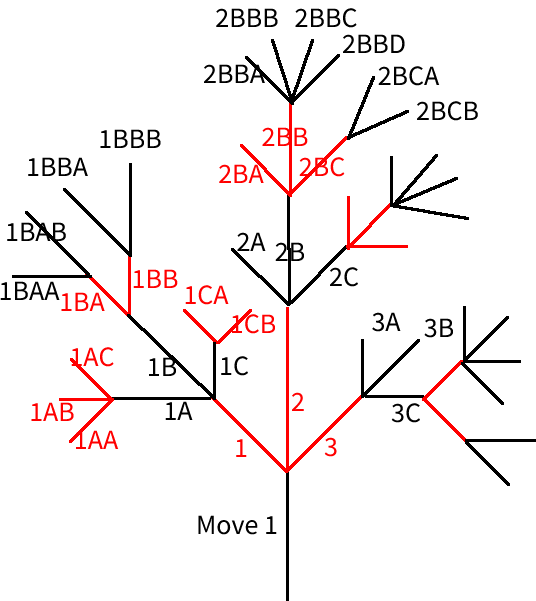
Secondly there are the tactical players who are adept at precise and deep calculation and usually adopt a forcing plan of fierce attack and/or strive for complications where their skills will be most use, but often ignore or are unaware of the broader positional aspects. They use a method of thinking that is basically: if I do 1 he can do 1 or 2 or 3, if he does 1 then I can do 1A, 1B or 1C. If I do 1A he can do 1AA, 1AB or 1AC …. etc.

This spreads out into a “tree” of analysis which soon becomes very complex indeed. See the diagram below – even after just 2 moves for each side there are a great many positions which needs to be visualised correctly and evaluated. And there’s another tree for each possible first move that I’m considering playing!

Tree of variations in chess

Thirdly and related to both in some ways, there are those who plan grand strategies and out-manoeuvre their opponent by stealth and cunning but who usually also require a good positional understanding like the first group to avoid weaknesses and also need calculation skills like the tacticians to finish off their plans.

(In case you’re wondering I am a tactician. Wild romantic attacks are my forte and I’m much less skilled at the positional side.)

It seems to me that like John, Nicholas has a very mechanistic mind. He is wonderful at building toys and machines and at planning long involved sequences of events. Yet John calls him innocent. I suspect that when we see him rising through the first few books he is thinking in a very tactical way – threat and counter-threat and counter-counter threat – but without any firm foundation to build on in terms of understanding of the basic concepts of what he is doing and more importantly why. Indeed as we see him progress he starts to try to act like the strategist, but because he lacks the basic soundness he makes mistakes and finds that his long involved sequences can go disastrously wrong.

Replace “innocent” with “naive” and it all starts to make more sense. He has to think everything through from first principles all the time because he hasn’t that grasp on the positional aspects – the automatic moral grounding that others take for granted – that allow him to start from a more advanced position and develop and learn from there. This is both a delight to his young and agile mind in that he can happily spend hours thinking things through with formidable concentration, and an almost fatal weakness in that he sometimes is so taken with the detail that he misses the bigger picture altogether.

To take the analogy one step further, I was very much like this as a teenage chess player – I calculated everything I could but was often outflanked by those with a better grasp of the whole. As I’ve grown up I’ve developed far more intuition and I’ve been able to build on the lessons of the earlier years – in life as well as chess after I returned to the game after 17 years away from it. I calculate less and trust to experience and judgement more.

In the case of Nicholas, I suspect that his disjointed childhood has left him with some of the moral and social guidelines missing, and he has been left to think through life for himself. But because his natural way of thinking has been mechanistic and he’s been often fighting for survival in one situation after another, he has taken a long time to learn to build the experience and general judgement that he needs.

I believe that one of the many reasons he mourns Umar so deeply is that he had started to provide that grounding and general awareness that was so lacking. Bereft of Umar’s guidance and under the extreme confusion and dislocation of Gelis’ wedding night revelation he reverts to type and undertakes more tactical responses to the events surrounding him.

How does Dorothy get him out of this situation? She brings in the most extreme form of intuition available to her – the divining and psychic episodes that make him cast about for explanations and seek to learn how to use these skills to understand people properly.

There is also the music – he treats it too in a mechanistic way at first but it soon becomes apparent that he has a “feel” for it and this is really another form of intuition. Perhaps one of the reasons he grows so close to Kathi is that she brings out this side of him.

************************

So those were my early thoughts during my first read. Fascinating to watch your old self making tentative connections. I’d intended to elaborate on this as I went through the final three volumes but for various reasons it didn’t happen. I later spent much more time deep-diving into Lymond and only really read all eight of Niccolo as a whole once or twice more during the intervening years. However I have returned to it and recently finished reading Unicorn Hunt again so maybe as I progress again through the remaining three I’ll remember to watch for these themes and will be able to return to add more points to this theory.

While Lymond’s places of interest are well visited, those that are unique to Nicholas are rather less so. This is partly because they are set further away from Edinburgh and the Borders which are the natural focus for most trips, and maybe a little because the scenery is a little less dramatic and there is less evidence on the ground that can be connected to the stories. However for House of Niccolo fans who want to get an idea of the landscape in which Dorothy placed Beltrees and Kilmirren a visit to Castle Semple Loch in the west of Scotland is a worthwhile trip.

The loch is a well-used facility for the local community – there is a sailing club, rowing club, windsurfing, and a bird-watching centre run by the RSPB. Curiously however it hasn’t been possible to walk right round the loch until recently. Following negotiations and path extensions the Semple Trail, the first parts of which were opened in May 2008 by Lord Jamie Semple, is now complete and runs fully around the loch and is already proving popular – indeed someone apparently complained to the council that it hadn’t been gritted during the recent very cold weather that reduced many of Scotland’s roads to near ice rinks!

Readers interested in this area can take  look at a couple of sites:

The Lochwinnoch Village website

which contains a number of interesting pages including some history of the real Crawford family of the area, and an extensive photo gallery which gives a good flavour of the area and includes a picture of the place known as Auld Simon. There’s also a section of old maps which I always find fascinating and some lovely old stories by a former park ranger. It seems to be a thriving community with a good sense of history and the site is worth exploring for a wealth of local information.

The Castle Semple Centre on the Visit Scotland site

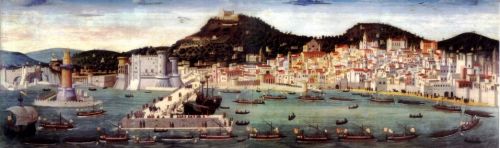
Back in 2004 I received an email from Andrew Daniels, an art writer and researcher who had recently been asked by an elderly lady if he could tell her anything about a print that she had of the Bay of Naples. He suggested to her that it probably dated from the 15th century and, as a panoramic view in its own right, was quite unusual, and that he would try to find out more. That brought him to the Dunnett website because the painting in question was one that was used as the cover for the Penguin edition of ‘Race of Scorpions’, details of which are available on the Bibliography page, with the information that it is attributed to Francesco Rosselli (1445 – c.1513), and depicts the re-entry of the Araganese fleet after the Battle of Ischia in 1442.

Much encouraged he had tried to find more information, such as the current location of the painting, but had so far drawn a blank, so he was writing to me to ask if I had any other sources of information on the painting or if the publishers might have any. I hadn’t, and knowing that the editors who’d worked on HN had since moved on I doubted if Penguin would either, but I was sufficiently intrigued to start my own net research, and being professionally involved with search engines I was able to find some resources that had escaped Andrew up till then.

Searching based around variants of “Francesco Rosselli Naples Napoli” etc. I found a couple of Italian sites, and although my knowledge of Italian is barely even rudimentary I was able to extract the name of the painting as being “Tavola Strozzi” with sufficient information to move on to some other sites. Now of course as soon the name Strozzi came up I was further intrigued. I’m not sure if Dorothy had any input into the cover designs but just maybe there was more to the choices than there appeared. Tavola appears to mean table, in the sense that the painting was done on wood, and it seemed that it was either commissioned or donated by Filippo Strozzi. It is now in the Museo di San Martino in Naples.

One of the sites is unfortunately no longer there but there is some useful information at some others including the following.

http://www.sullacrestadellonda.it/toponomastica/gn_toponindex.htm
http://www.storia.unina.it/strozzi.html
http://www.mcah.columbia.edu/naples/html/naples_map_strozzi.html

Edit – April 2026
These three links above are sadly no longer valid as the sites have been completely reorganised or are no longer in existence. However I have found the following four sites:

https://www.researchgate.net/figure/ew-of-Naples-tavola-Strozzi-painting-on-wood-XV-century-Source-Museo-nazionale-di-San_fig5_322083532
This one has a lovely added Dunnett connection as it takes its source from a book called Italy Seen Through the Eyes of Anselmo Adorno. A Testimony of the Middle Ages.

http://www.naplesldm.com/strozzi.php
This one is probably the most well researched and explains the various ideas about the painter and the occasion depicted.

https://www.wikiart.org/en/francesco-pagano/tavola-strozzi-1487
This Wikiart page attributes it to another painter, Francesco Pagano.

There is a Wikipedia page but it’s only a stub, and the link it has to the National Museum of San Martino, Naples, where the painting now resides, does not load. Pages under its name are all for visiting and buying tickets rather than describing the contents.

http://www.tavolastrozzi.it/studio.htm
Finally this site discusses the viewpoint and techniques used in the painting.
End of Edit

Although some of the sites appeared to suggest that the painting was anonymous others suggested that Francesco Rosselli was an accurate attribution. However the date of the depiction quoted on the book cover seemed to be doubtful and 1465 appeared to be suggested instead, with the painting donated by Strozzi in 1472/3. Andrew thanked me for my research pointers and, being familiar with the 14th and 15th centuries, felt that these dates would fit in well with Filippo Strozzi’s return to Florence in 1466, after his family’s banishment by the Medici in 1434. Filippo had been on intimate terms with the Italian courts, especially Naples, and a gift sent there after his very ‘grand’ re-establishment in Florence would help to cement his status.

He further felt that the suggested date for the naval depiction in the Italian extract I’d sent him – 1465 – seemed more sensible than the 1442 Battle of Ischia suggested by Penguin. It celebrates a victory achieved under the current regime (Ferdinand I of Naples, from 1458), and more or less coincided with Filippo’s return to Florence. Thus seeming more relevant to both parties.

At this point Andrew confessed that he had “only read the first two volumes of ‘Niccolo’ – they’re both still on my bookshelves, and I never got round to the rest”. I replied that while they were perhaps not the easiest of books to read because of the many puzzles and complex plots, they contained rich and meticulously researched descriptions of 15th century life in Europe and would repay the time spent in all sorts of ways. He later promised he would return to them.

Andrew continued his research and told me he’d found reference to the picture in Alison Cole’s ‘Art of the Italian Renaissance Courts’; which had been on his bookshelves all the time! (That sort of thing happens to me too!) He also found Lorenzo de’ Medici’s visit to Naples in Macchiavelli’s ‘History of Florence’ (Chapter IV), though unfortunately the website on which this was available at the time is no longer holding it.

Not long after he sent me a copy of the report he’d given to the owner of the print who had started the enquiry, and indicated that she was very happy with it.

—————

Your picture of Naples is known as the Tavola Strozzi, or Table of the Strozzi, because it was painted on wood, common practise at the time. The original is in the Museo di San Martino in Naples. Topographical views were popular in the later 15th century because of the influx into Italian Courts of Flemish paintings, which included detailed landscapes.

The Strozzi were a famous and powerful family in Florence, but from 1434 – 66, they were banished from there by the Medici, the ruling family. As a result, Fillipo Strozzi, born in 1438, became well known in several princely courts, especially Naples, where he gained wealth and influence. Naples was ruled at that time by the house of Aragon, and from 1458 to 1494 by Ferrante of Aragon, also known as Ferdinand the First.

The Strozzi were allowed back into Florence in 1466, and Fillipo returned in grand style, becoming even more wealthy and powerful. He built a famous palazzo there for himself and his family, and became a trusted advisor to Lorenzo de Medici, the leader of Florence’s Republic.

It’s believed that Fillipo commisioned your picture of Naples from a Florentine map-maker and artist called Francesco Rosselli, in order to present it as a gift to Ferdinand in Naples. This would have been a shrewd move, as gifts to prestigious acquaintances underlined his own status in Florence. It’s not certain that Francesco painted it, but it seems likely as he too had spent much time in Naples. It was painted in 1472 or 1473, and supposedly depicts the triumphant re-entry into the Bay of Naples of Ferdinand’s fleet, after he’d routed his Angevin enemies in the Battle of Ischia in 1465.

The picture may also be connected to a daring diplomatic visit made by Lorenzo de Medici to Naples in 1479, when the Florentines were under threat from an alliance made up of Naples, Milan and Pope Sixtus IV. Lorenzo personally sailed into Naples, spending several months there and completely winning over Ferdinand and his people. Lorenzo emerged a hero, celebrated for his international statesmanship. (In fact, there was more to it than that, but that’s the legend!) The picture may have been presented to Ferdinand on the occasion of Lorenzo’s visit in 1479, whether as a gift from Fillipo Strozzi or Lorenzo himself is debateable. This seems likely given Fillipo’s links with Naples and his position of trust with Lorenzo – he must have been seen as a perfect mediator by Lorenzo, and encouraged to exploit his connections?

———-

Altogether a perfect illustration of the sort of delightful byways that reading Dunnett can take you down. We have a number of Italian readers amongst the newsletter recipients and discussion groups. Perhaps one of them can add something to this research? Dorothy’s books were well translated into Italian and still sell well there, and she always enjoyed her promotional trips as well as the research ones. She once told me that the head of her Italian publisher was also a director of La Scala Milan and used to get her the best seats in the house for the opera, which she adored.

I wonder if any of the other cover paintings have similar connections to the stories…