Category Archives: Book discussion

This page – which was the original address of this post prior to the server failure in early 2025 – is now a pointer to where the page now resides.

https://www.dorothydunnett.co.uk/taken-on-a-journey-to-blackfriars.php

I’ve done this so that the comments which had been submitted can still be read, (they’re at the bottom of that page) since I can’t enter them into this post.

If, after reading the article, you would like to leave a new comment, please do it here
On how easy or hard it is “getting into” the Lymond Chronicles

Unlike most of the posts here this one avoids spoilers apart from a few very early quotes and a very general hint about the hero, so is safe for anyone just starting their Dunnett reading experience.

With many more people turning to books to help them get through the coronavirus lockdown, we’re seeing plenty of new readers for Dorothy’s first series and many are turning up on my Twitter timeline. Some of them have clearly become entranced immediately, but inevitably a few are finding things harder. This has revived discussion of the old question (no, not that one!) of how easy or difficult it is to get comfortable with Game of Kings and our prickly hero, and how far readers should persist with it if they’re finding it difficult.

For instance in a thread earlier today, Dunnettcentral joined the discussion with

People often say they find Game of Kings hard to get into. (Two in my own family) This baffles me, as I adored it from the start. No, I didn’t understand a lot of it, but I didn’t care, I was enthralled.

to which long-time reader Grandma Ogre responded

I was 14. I’d never read anyone who could make English weep, sing, stab – and fly! like that. Understand it, nope; I just wanted to stand under it and experience it.

If only everyone was so fortunate. I’ve said before that I had none of those problems, but it doesn’t baffle me that many people do as I was aware very quickly that I was in a very privileged position. I was about to respond on the thread but realised that it would require multiple posts, so I decided to turn it into a blog post instead.

Ooooh, what a lucky man he was

Firstly I’d met Dorothy already, albeit very briefly at that point, and had already twigged that there was a mischievous and lively intelligence behind her disarming smile. So I was almost expecting misdirection, and was certainly not disappointed there! Most new readers, unless forwarned by friends, have no such suspicion that she’ll be working in deep and multiple layers of complexity; that the characters we’ll meet will have heavily biased opinions and will have been given evidence that’s wildly innaccurate in a way that makes our modern “fake news” seem perfectly straightforward by comparison; and that, unlike almost every other author most of them have ever read, she’ll never show you anything from the main protagonist’s viewpoint! (until book 6).

The opening sequences looking up from the Nor Loch were of course a scene I knew well and that was a second advantage – I’m an Edinburgh lad born and bred and with a keen interest in its history and knew the layout and landscape intimately – so I could envisage the scenes without even thinking about them and thus had more room to appreciate the quality of the descriptions, which even at this early stage are wonderfully composed. The language was also immediately accessible to me – not just the Scots words and speech patterns but there was something Scottish in the cadence and rhythm of it that was immediately familiar and comfortable; and again the average reader – particularly those from outside the UK – wouldn’t have that. In contrast they would need to try to assimilate all this while trying to work out who the characters were, what relation they have to the story, get some sort of grasp on the basic history, and assess the character of the man whose name suggests he is the focus of the series.

Knowing me knowing you – Aha!

And I had a third advantage which many don’t have – a mind brought up on the complexities of chess and the mysteries of Sherlock Holmes. It soon became apparent that Dorothy had a mind ideally suited to puzzles and intricacies, multilayered and full of false trails and red herrings. While I couldn’t possibly match her on the literary allusions or the foreign languages, I at least had the sort of thinking processes that would allow me to follow the devious plot twists and perhaps more importantly to work out what were the the important structural elements in the story while temporarily laying aside some of the aspects (like Latin or Middle French poetry and quotations) that I didn’t immediately understand until I could follow them up – not allowing them to be a distraction from the crucial ones.

Even then, I recall very well that there was a point fairly early on in my first read where I saw a reference to something that had been said earlier and stopped dead in my tracks. I remember thinking to myself that I wasn’t paying enough attention, wasn’t concentrating enough despite being a slow and deep reader. That this author had to be watched ultra-carefully for connections that could be oh-so-easily missed as they were dropped casually into the dialogue or hidden amongst a passing description. That this book deserved the levels of intense concentration I had once given to match-play chess. And so I went back and re-read from the start until I was sure that I had settled into a sufficiently immersed reading method. I have to wonder if a speed reader would have any chance at all of understanding what is going on! And how that might affect their ability to be captured by the story.

And one must acknowledge that on top of all these aspects there is a further problem for new readers. Dorothy was writing her first novel, never knowing whether it would ever be published, and there is an undeniable feeling of her throwing in everything including the kitchen sink! The language is a little flowery in places, the quotes that flow from Lymond’s lips in multiple tongues can be a little overpowering, and that’s without even considering the impossibly complex politics. I could easily see some readers finding it all a bit too much.

Got a feeling inside (Can’t explain)

How easy it would be to throw up your hands in desperation – who are all these characters, who all seem to have multiple names? How are we supposed to like this scum-bag of a character? He’s set fire to his mother’s home, robbed her neighbours, even thrown a knife at one of them! He verbally rips his own men to shreds, confuses and confounds a potential disciple, and makes him fire an arrow at one of those men. He flirts with his brother’s wife, insults the man himself and generally acts like a criminal and traitor. Who is the hero? Is there a hero or is he going to turn out to be a Flashman scoundrel? When is anyone going to explain anything?

Why was I so sure that it all would come out in the end? So certain that Lymond would turn out ot be on the side of the angels. Well part of it is that Scottishness I mentioned earlier – we’re never simple and straightforward, always underdogs, always doing gloriously daft things for the right reasons but against all caution and advice, and seldom getting the rewards… except maybe in fiction.

Caledonia’s been everything I’ve ever had

There’s one further influence that I had that maybe helped/swayed me a little in a positive direction, and which few other readers would have. I had grown up reading The Scotsman, and that newspaper had been turned into a leading and respected national institution by one man – Alastair Dunnett, Dorothy’s husband. Although I was still a young man when he switched from being the Scotsman editor to his later role as Chairman of Thomson North Sea Oil, his influence permeated the paper for many years afterwards and I had read many of his editorials (does anyone read editorials now?) and later occasional articles. For many years my writing style was largely based on his.

He was universally respected – I once saw him described in the Scots Magazine as “a man of total integrity”. He was devoted to Scotland despite many lucrative offers to take him elsewhere. He’d been offered the editorship of The Times when it was a position of immense importance and political influence. It was impossible to imagine that Dorothy would write a principal character who would turn out to be a knave, when she had his example and reputation behind her. I doubt I consciously thought about it at the time but the subconscious idea will certainly have been lurking there.

Carry on my wayward son (or daughter)

So for those of you who might be struggling in Game of Kings or who have previously tried and given up – I have considerable sympathy for your confusion and frustration. You probably have none of these advantages that I did.

But please don’t give up!

Read to at least 100 pages, by which point you may well start to change your mind. You’ll meet a character who makes you reassess every problem you’ve had with story and characters so far, and crucially shows you something more of the author’s wicked sense of humour.

Now I can’t guarantee that if you get that far that you’ll fall in love the way I and many thousands of readers have – not everyone likes Dunnett any more than everyone likes Beethoven – but if you’re drawn to this type of writing at all then it is very, very likely. And like many of us it could literally change your life and give you interests it topics and places and cultures that will enrich your life in ways you can’t yet imagine. Even just in the purely literary sense you’ll find a skill in the use of language that will give you lifelong pleasure. Grandma Ogre’s description is absolutely spot on – Dorothy “could make English weep, sing, stab – and fly!” She can teach you to understand, to observe and describe, to delight in the interplay of words and concepts in a way that few other authors even approach. These books are worth the effort a thousand times over!

That opening line (sorry, ran out of song titles)

For the folks who were immediately entranced I disagree on only one single thing. I hear many who say that they were hooked by the opening phrase “Lymond is back”. I wasn’t. It was an ok opening but it didn’t grab me; and compared to some of the other quite brilliant opening lines she would come up with later it pales into the merely good. For me it was a gradual increasing admiration through the first chapter, where we had progressively:

“Across four hundred feet of black lake, friezelike on their ridge, towered the houses of Edinburgh. Tonight the Castle on its pinnacle was fully lit, laying constellations on the water…”

“…oriflamme…”

“”I,” said Lymond, in the voice unmistakably his which honeyed his most lethal thoughts, “am a narwhal looking for my virgin. I have sucked up the sea like Charybdis and failing other entertainment will spew it three times daily, for a fee.”

“The sow approached her water dish, sniffed it with increasing favour, and inserted both her nose and her front trotters therein.”

followed not long after by the delightful follow-up

“She bounced once off the newel post, scrabbled once on the flags, trotters smoking, then shot Mungo Tennant backward, squealing thickly in a liberated passion of ham-handed adoration.”

By “trotters smoking” I was certain – this was unlike anything I’d ever read. And every chapter from then on confirmed it.

I’ve never for a second regretted becoming so immersed in these books – if you’re having problems with them do give them enough time to work their magic on you.

(no song titles or lyrics were harmed in the making of these headings, but maybe I’m going just a bit stir-crazy like everyone else in this lockdown – stay safe everyone.)

A while back I was re-reading Game of Kings for the Edinburgh discussion group, and thought, not for the first time, to take a closer look at the geography of that lovely passage introducing us to the hopelessly romantic 13-year old Agnes Herries, and giving us a glimpse of Richard’s wry sense of humour. In doing so I realised properly a couple of things that had lain at the back of my mind on previous readings, and was led into a little investigation.

Let’s firstly take a look at the placenames mentioned and see if we can trace a few things about Richard’s journey. All is not quite what it seems, even when you think you have some knowledge!

Incidentally, isn’t the first line of the chapter classic Dorothy?

On Sunday, the day after the affair at Lake of Menteith, Lord Culter was also taking aquatic exercise of a kind which all but turned his epithalamics into elegies.

How many of us had to look that phrase up to make sure we understood it? 😉 It could have come straight out of Lymond’s verbal extravagances.

Richard has been in South-west Scotland with a small harrying force taking advantage of Wharton’s retreat and then trying to convince some of the border families who are being hard pressed by the English to remain loyal to the Scottish cause. We are told that he’s had a fair degree of success and it appears that he has considerable powers of political persuasion as well as practical military leadership. How skillfully she builds up our knowledge of him without resorting to simple direct description.

He is on his way back home when he remembers that he has an escort task to undertake and

“…turned aside at Mollinburn with six horsemen to ride through the Lowthers to Morton.”

So our first task is to find Mollinburn and get ourselves oriented. This proved harder than expected as both Google and Bing are not great on Scottish minor placenames. I found a Mollinsburn, but it was much too far north – north-east of Glasgow in fact (which would confuse me further later on). I knew roughly where the Lowthers (a range of hills) were, though it was a very long time ago that I had once walked there and my memory of their precise position was sketchy.

Being in Slovenia with no access to my collection of paper maps back in Edinburgh I had to rely on the online variety, but it’s far harder working on a relatively small screen than a map spread out on a tabletop. Most online maps are lacking in any sort of detail even when you zoom in and out. Bing has a bit more detail than Google but here I was at first misled. I found Lowther Hill and Green Lowther but they’re quite far north – beyond the A702 road towards Wanlockhead – and I coulldn’t work out why Richard would have gone that far north and then back south for his meeting. However while casting about for further information I came across an inset online version of a Bartholomews map. Bartholomews  are an old Scottish firm of map-makers whose maps, while lacking some of the fine detail of the Ordnance Survey, were excellent for visualising an overall area or trip and tended to give prominent names to ranges of hills rather than naming all the individual ones. On that map the Lowthers were indicated in two sweeps – a long one running NNW and a shorter one running NNE and forming a V shape starting much further south than the individual hill from which the name comes. So I had a bit more to go on but still could find no sign of Mollinburn.

At that point I switched back to Bing. If you are set in Bing as being in the UK then you have a very useful faciity invisible to everyone else – at certain magnifications you get the option of viewing UK Ordnance Survey maps which are superbly detailed and the must-have map for hill walkers. I started looking on there and after a lot of scrolling around I found Mollinburn – not even a hamlet but merely a house just off the A701 road which runs between Dumfries and Beattock; about a mile south of the village of St Ann’s. So we have a start point. Now for the next named waypoint – Morton.

Again the search engines are useless – no sign of Morton. So it’s a question of looking to the next named place and trying to work back from there.

On Sunday afternoon, the party he was expecting came in from Blairquhan, and he left Morton on the Sanquhar road to take the Mennock Pass north.

Sanquhar is much easier to find – it’s a village away to the north-west on the A76 – and pulling back south you find Mennock which marks the entrance to the pass running north-east. So Morton must be somewhere on the road south of there. Sure enough, detailed perusal of the Ordnance Survey maps brings up the ruins of Morton Castle, situated above Morton Loch about ¾ mile east of Carronbridge on the A702, and with a few other Morton related names around it. It was built by the Earl of Morton who was a Douglas, and just across the valley to the west is that other Douglas stronghold, Drumlanrig Castle, of which more later.

We can now see that Richard rides across the southern slopes of the Lowther Hills from Mollinburn; either heading northwest and then west and skirting around the Forest of Ae, or going through the forest to begin with, though there’s no obvious path visible now. Whichever way it was the riding must have been rough and we can admire the stamina of the riders. He had started north on the Friday so I would imagine he probably stayed the night somewhere around Morton before meeting the party bringing Agnes on Sunday.

Here we must also look at where they were coming from. On previous reads I had rather lazily mentally assumed they were probably coming from around Terregles, but the text tells us explicitly if we care to check and given the recent English advance it then makes perfect sense. They were coming from Blairquhan where Agnes’ grandfather is based and we must assume that she was moved there to avoid the danger of being taken for ransom.

Blairquhan is about 40 miles to the west in South Ayrshire so a decent length journey on horseback just to get to the meeting with Richard. We know that he and Agnes are now heading for Stirling to join the court who have retreated there for safety after the eastern English advance towards Edinburgh. Morton to Stirling is another 75 miles, which again gives us pause to consider the problems of travelling in those times.

After a diversionary description of Agnes and her romances we come to the meeting with Dandy Hunter. Initially it’s not clear how much further we have travelled and on my earliest reading many years ago I initially assumed we had gone a considerable distance. The reason behind this was that I’d heard of Ballagan, the name of Dandy’s estate, and knew it was near Strathblane in the Campsie Fells, between Glasgow and Stirling. That seemed to make sense since they were headed to Stirling. However at this point things start to get geographically confusing and I realised I must be mistaken, though it was only now that I got around to resolving the matter properly.

Look,” said Hunter. “We’ll drown if we exchange news here. Come with me to Ballaggan – you could do with something hot inside you anyway.

Suggests they must be close to Hunter’s house…

But again, they had halted. The Nith, which lay between themselves and Ballaggan, ran unusually fast and high at their feet, and an outrider who drove his horse in at the ford thudded out again, wet to the stirrups.

Hang on! The Nith? That’s the river that runs from west of Sanquhar, turns south down the valley through Morton and down to Dumfries, then on till it empties into the Solway Firth. If we’d gone through the Mennock Pass we’d have left it far behind, so if we’re crossing it then we must still be in that valley and not have gone very far at all. And if that’s the case Ballaggan should be to the west of the river since Morton is on the east side.

And of course after the near disaster crossing the river they’re taken to Drumlanrig, because it’s nearer! (Slaps forehead!)

For they were in a Douglas household, instead of Hunter’s elegant, exhausted estate of Ballaggan. Alone and without help, Richard had brought Agnes Herries ashore: his own men were upstream and Andrew Hunter, far ahead, had been deaf to his shouts. But afterward, warned by the commotion, he had raced to their aid, wrapped the girl in his own cloak and carried both swimmers to Drumlanrig, the cavalcade following. Ballaggan was nearly an hour’s journey away and could wait. These two could not.

So, clearly the Ballagan I knew about away to the north cannot be Dandy’s place. Hmmm, wait, there’s two g’s in Dorothy’s version and only one in the Strathblane name! On its own that’s not a certainty since spelling in those times could be so variable and often changed over the years, but the geography is surely decisive. But searching for Ballaggan just seems to bring up Ballagan. Google knows best even when it doesn’t.

At this point I’m beginning to think that maybe Dorothy borrowed the name and tweaked it; maybe this Ballaggan is fictitious like Midculter and Flaw Valleys. No, that’s not her way. It must be based on something more.

Back to the maps. West of the Nith, north of Drumlanrig, south of Mennock. Nothing on Google – hardly anything named at all in that area on either normal map or aerial. Same with Bing.

An hour’s ride – how far can a horse travel in an hour – 8 to 12 miles apparently.

Comparing the two more detailed maps, Bartholomews and Ordnance Survey, you’d barely think you were looking at the same area. Hmmm just found a place called Buck Cleuch – could it be the place of the legend  – of the Scott who saved the King from a stag and was known thereafter as Buck Cleuch, later Buccleuch. Seems a bit westerly but who knows? It might be. But actually, maybe I am too far west myself, back up a bit towards the river, and change the magnification so we get more detail.

Come on man, you’re a search specialist, let’s delve a bit deeper and stop accepting what Google thinks we’re looking for. A bit more digging and we find a Ballaggan Cottage, the right spelling, Marrburn, Thornhill, Dumfries and Galloway, so it’s the right area, “within walking distance is Drumlanrig Castle”, surely we’re on the track now. “2 bedroom cottage situated within the Buccleuch Estate”, so these were Buccleuch lands – maybe that is the place of the legend.

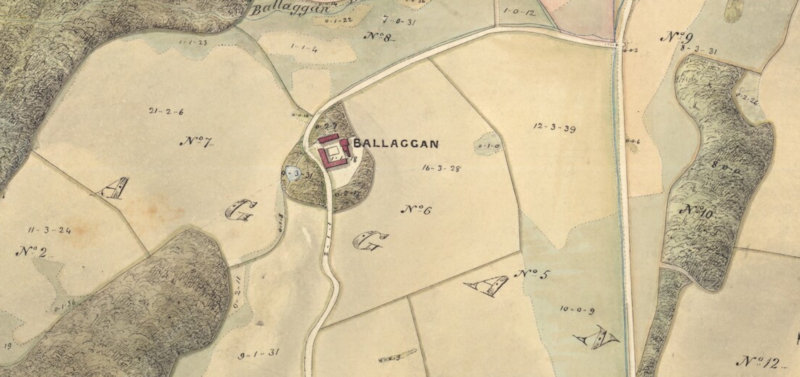
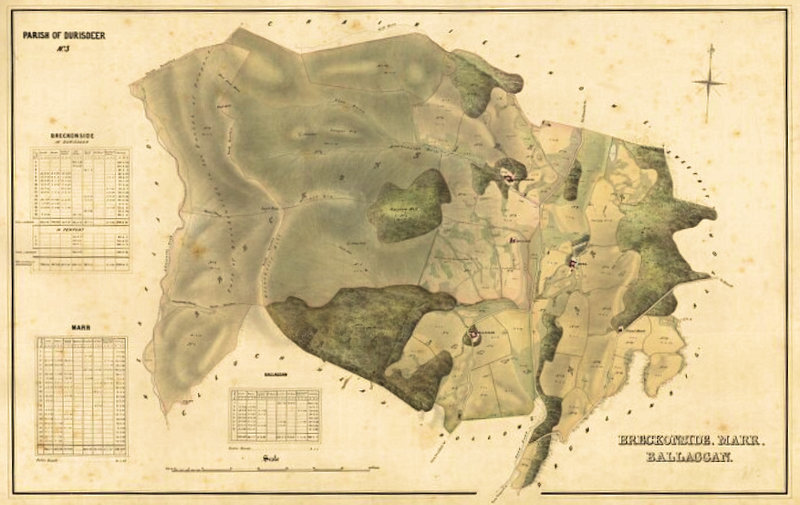
A bit more searching… Gotcha! National Library of Scotland, Estate Maps of Scotland, 1750s-1900s, Breckonside, Marr, Ballaggan. Queensberry Estate Plans, 1854
Volume 3. Courtesy of Buccleuch Estates.

Here’s a look at the whole map first

Ballaggan map

It looks beautifully hand-drawn but then you realise you can zoom right in.

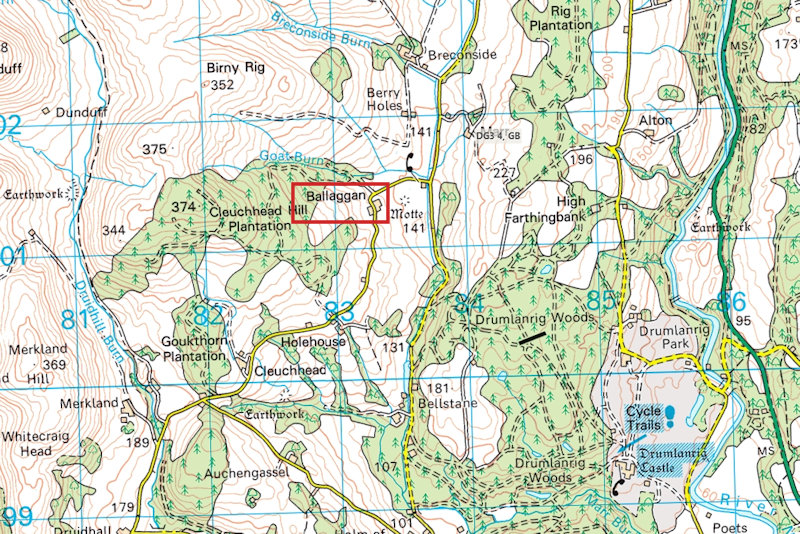
Looks fairly small, and like more of a tenant farm than an estate, so maybe Dorothy was exaggerating or maybe it was bigger in earlier times, but we’ve found it; she did base it on a real place. Of course she was friends with the Buccleuchs so I wonder if she saw this original map that that is now digitally archived to the NLS, during a visit. Would be lovely to think so. You can view the map yourself at https://maps.nls.uk/view/129393259

Now, final task, relate that to the modern maps, adjust the magnification again and there it is. So obvious when you know where to look 😉

Well, after all that I have considerable respect for Richard and Agnes for their riding ability – a 13 year-old riding 115 miles, much of it over rough ground, to visit the court has a lot of grit.

And who would have thought that Dandy Hunter and his estate would turn out to be not quite what he appeared?!

Amazing how much investigative fun you can have with one small passage. Another toast dear lady! And I hope they have Talisker in heaven.

I’m currently in the process of rebuilding the main website and while considering the structure of the content I realised that I’ve written very little here about the House of Niccolo compared to the substantial amount devoted to the Lymond Chronicles. I then remembered a piece I’d written on one of the email discussion groups many years ago and thought to look it out and see what I was thinking back then. It was in February 2000 and I had only read the first five books through Unicorn Hunt, but hadn’t yet started To Lie with Lions. (I would read that and Caprice and Rondo just in time for the release of Gemini.)

I had been thinking about a discussion thread that revolved around Nicholas as an “innocent”, and while considering some of the various arguments I’d come up with a tentative theory of Nicholas’ life and growth. In some ways this was an alternative to the “compartmentalised” theories that some readers had come up with, although there were aspects of those that I agreed with.
So here is that early theory of Nicholas and how he thinks and operates – wrapped in the chess metaphor that I used to illustrate it.

****************

Nicholas as Chess Player

First of all I rather like the ideas mentioned in the original thread about Nicholas being an innocent in various different ways, and also the idea about each of the characters seeing Nicholas only in a way that they can relate to, but in particular my growing fondness for John Le Grant and his opinions has suggested something else.

I’m going to use a chess metaphor for this theory – it seems somehow appropriate and it’s an area I am obviously comfortable and experienced with and also allows me to relate my own character to Nicholas (hitherto I’ve tended to identify more with Francis – just wish I had his many skills in remotely the same abundance!) So I guess that means I get to make the same mistake as the characters!

To explain to those who don’t play chess in case they don’t get my drift: Different players play in different styles – there are those who are good all-round players but they are rare – usually players fall into two or three different camps.

Firstly there are those who have a natural or acquired feel for the positional side of the game and who naturally set up positions that are structurally sound before doing anything else. Their pieces are usually working in harmony with each other and the pawn structures are usually solid. They are difficult to beat because of this.

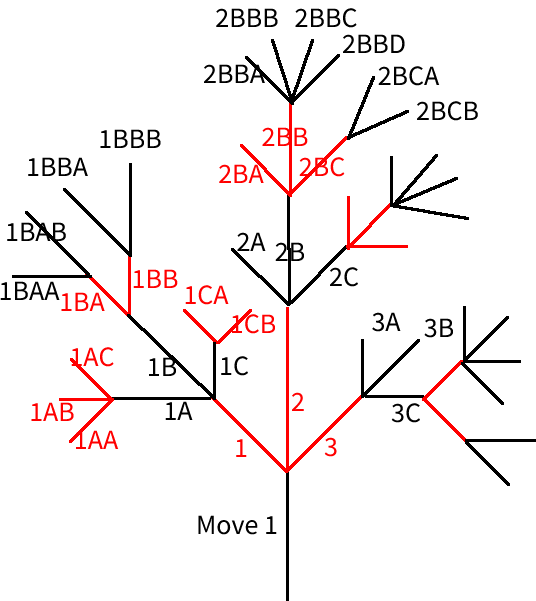
Secondly there are the tactical players who are adept at precise and deep calculation and usually adopt a forcing plan of fierce attack and/or strive for complications where their skills will be most use, but often ignore or are unaware of the broader positional aspects. They use a method of thinking that is basically: if I do 1 he can do 1 or 2 or 3, if he does 1 then I can do 1A, 1B or 1C. If I do 1A he can do 1AA, 1AB or 1AC …. etc.

This spreads out into a “tree” of analysis which soon becomes very complex indeed. See the diagram below – even after just 2 moves for each side there are a great many positions which needs to be visualised correctly and evaluated. And there’s another tree for each possible first move that I’m considering playing!

Tree of variations in chess

Thirdly and related to both in some ways, there are those who plan grand strategies and out-manoeuvre their opponent by stealth and cunning but who usually also require a good positional understanding like the first group to avoid weaknesses and also need calculation skills like the tacticians to finish off their plans.

(In case you’re wondering I am a tactician. Wild romantic attacks are my forte and I’m much less skilled at the positional side.)

It seems to me that like John, Nicholas has a very mechanistic mind. He is wonderful at building toys and machines and at planning long involved sequences of events. Yet John calls him innocent. I suspect that when we see him rising through the first few books he is thinking in a very tactical way – threat and counter-threat and counter-counter threat – but without any firm foundation to build on in terms of understanding of the basic concepts of what he is doing and more importantly why. Indeed as we see him progress he starts to try to act like the strategist, but because he lacks the basic soundness he makes mistakes and finds that his long involved sequences can go disastrously wrong.

Replace “innocent” with “naive” and it all starts to make more sense. He has to think everything through from first principles all the time because he hasn’t that grasp on the positional aspects – the automatic moral grounding that others take for granted – that allow him to start from a more advanced position and develop and learn from there. This is both a delight to his young and agile mind in that he can happily spend hours thinking things through with formidable concentration, and an almost fatal weakness in that he sometimes is so taken with the detail that he misses the bigger picture altogether.

To take the analogy one step further, I was very much like this as a teenage chess player – I calculated everything I could but was often outflanked by those with a better grasp of the whole. As I’ve grown up I’ve developed far more intuition and I’ve been able to build on the lessons of the earlier years – in life as well as chess after I returned to the game after 17 years away from it. I calculate less and trust to experience and judgement more.

In the case of Nicholas, I suspect that his disjointed childhood has left him with some of the moral and social guidelines missing, and he has been left to think through life for himself. But because his natural way of thinking has been mechanistic and he’s been often fighting for survival in one situation after another, he has taken a long time to learn to build the experience and general judgement that he needs.

I believe that one of the many reasons he mourns Umar so deeply is that he had started to provide that grounding and general awareness that was so lacking. Bereft of Umar’s guidance and under the extreme confusion and dislocation of Gelis’ wedding night revelation he reverts to type and undertakes more tactical responses to the events surrounding him.

How does Dorothy get him out of this situation? She brings in the most extreme form of intuition available to her – the divining and psychic episodes that make him cast about for explanations and seek to learn how to use these skills to understand people properly.

There is also the music – he treats it too in a mechanistic way at first but it soon becomes apparent that he has a “feel” for it and this is really another form of intuition. Perhaps one of the reasons he grows so close to Kathi is that she brings out this side of him.

************************

So those were my early thoughts during my first read. Fascinating to watch your old self making tentative connections. I’d intended to elaborate on this as I went through the final three volumes but for various reasons it didn’t happen. I later spent much more time deep-diving into Lymond and only really read all eight of Niccolo as a whole once or twice more during the intervening years. However I have returned to it and recently finished reading Unicorn Hunt again so maybe as I progress again through the remaining three I’ll remember to watch for these themes and will be able to return to add more points to this theory.