Category Archives: Lymond Chronicles

On how easy or hard it is “getting into” the Lymond Chronicles

Unlike most of the posts here this one avoids spoilers apart from a few very early quotes and a very general hint about the hero, so is safe for anyone just starting their Dunnett reading experience.

With many more people turning to books to help them get through the coronavirus lockdown, we’re seeing plenty of new readers for Dorothy’s first series and many are turning up on my Twitter timeline. Some of them have clearly become entranced immediately, but inevitably a few are finding things harder. This has revived discussion of the old question (no, not that one!) of how easy or difficult it is to get comfortable with Game of Kings and our prickly hero, and how far readers should persist with it if they’re finding it difficult.

For instance in a thread earlier today, Dunnettcentral joined the discussion with

People often say they find Game of Kings hard to get into. (Two in my own family) This baffles me, as I adored it from the start. No, I didn’t understand a lot of it, but I didn’t care, I was enthralled.

to which long-time reader Grandma Ogre responded

I was 14. I’d never read anyone who could make English weep, sing, stab – and fly! like that. Understand it, nope; I just wanted to stand under it and experience it.

If only everyone was so fortunate. I’ve said before that I had none of those problems, but it doesn’t baffle me that many people do as I was aware very quickly that I was in a very privileged position. I was about to respond on the thread but realised that it would require multiple posts, so I decided to turn it into a blog post instead.

Ooooh, what a lucky man he was

Firstly I’d met Dorothy already, albeit very briefly at that point, and had already twigged that there was a mischievous and lively intelligence behind her disarming smile. So I was almost expecting misdirection, and was certainly not disappointed there! Most new readers, unless forwarned by friends, have no such suspicion that she’ll be working in deep and multiple layers of complexity; that the characters we’ll meet will have heavily biased opinions and will have been given evidence that’s wildly innaccurate in a way that makes our modern “fake news” seem perfectly straightforward by comparison; and that, unlike almost every other author most of them have ever read, she’ll never show you anything from the main protagonist’s viewpoint! (until book 6).

The opening sequences looking up from the Nor Loch were of course a scene I knew well and that was a second advantage – I’m an Edinburgh lad born and bred and with a keen interest in its history and knew the layout and landscape intimately – so I could envisage the scenes without even thinking about them and thus had more room to appreciate the quality of the descriptions, which even at this early stage are wonderfully composed. The language was also immediately accessible to me – not just the Scots words and speech patterns but there was something Scottish in the cadence and rhythm of it that was immediately familiar and comfortable; and again the average reader – particularly those from outside the UK – wouldn’t have that. In contrast they would need to try to assimilate all this while trying to work out who the characters were, what relation they have to the story, get some sort of grasp on the basic history, and assess the character of the man whose name suggests he is the focus of the series.

Knowing me knowing you – Aha!

And I had a third advantage which many don’t have – a mind brought up on the complexities of chess and the mysteries of Sherlock Holmes. It soon became apparent that Dorothy had a mind ideally suited to puzzles and intricacies, multilayered and full of false trails and red herrings. While I couldn’t possibly match her on the literary allusions or the foreign languages, I at least had the sort of thinking processes that would allow me to follow the devious plot twists and perhaps more importantly to work out what were the the important structural elements in the story while temporarily laying aside some of the aspects (like Latin or Middle French poetry and quotations) that I didn’t immediately understand until I could follow them up – not allowing them to be a distraction from the crucial ones.

Even then, I recall very well that there was a point fairly early on in my first read where I saw a reference to something that had been said earlier and stopped dead in my tracks. I remember thinking to myself that I wasn’t paying enough attention, wasn’t concentrating enough despite being a slow and deep reader. That this author had to be watched ultra-carefully for connections that could be oh-so-easily missed as they were dropped casually into the dialogue or hidden amongst a passing description. That this book deserved the levels of intense concentration I had once given to match-play chess. And so I went back and re-read from the start until I was sure that I had settled into a sufficiently immersed reading method. I have to wonder if a speed reader would have any chance at all of understanding what is going on! And how that might affect their ability to be captured by the story.

And one must acknowledge that on top of all these aspects there is a further problem for new readers. Dorothy was writing her first novel, never knowing whether it would ever be published, and there is an undeniable feeling of her throwing in everything including the kitchen sink! The language is a little flowery in places, the quotes that flow from Lymond’s lips in multiple tongues can be a little overpowering, and that’s without even considering the impossibly complex politics. I could easily see some readers finding it all a bit too much.

Got a feeling inside (Can’t explain)

How easy it would be to throw up your hands in desperation – who are all these characters, who all seem to have multiple names? How are we supposed to like this scum-bag of a character? He’s set fire to his mother’s home, robbed her neighbours, even thrown a knife at one of them! He verbally rips his own men to shreds, confuses and confounds a potential disciple, and makes him fire an arrow at one of those men. He flirts with his brother’s wife, insults the man himself and generally acts like a criminal and traitor. Who is the hero? Is there a hero or is he going to turn out to be a Flashman scoundrel? When is anyone going to explain anything?

Why was I so sure that it all would come out in the end? So certain that Lymond would turn out ot be on the side of the angels. Well part of it is that Scottishness I mentioned earlier – we’re never simple and straightforward, always underdogs, always doing gloriously daft things for the right reasons but against all caution and advice, and seldom getting the rewards… except maybe in fiction.

Caledonia’s been everything I’ve ever had

There’s one further influence that I had that maybe helped/swayed me a little in a positive direction, and which few other readers would have. I had grown up reading The Scotsman, and that newspaper had been turned into a leading and respected national institution by one man – Alastair Dunnett, Dorothy’s husband. Although I was still a young man when he switched from being the Scotsman editor to his later role as Chairman of Thomson North Sea Oil, his influence permeated the paper for many years afterwards and I had read many of his editorials (does anyone read editorials now?) and later occasional articles. For many years my writing style was largely based on his.

He was universally respected – I once saw him described in the Scots Magazine as “a man of total integrity”. He was devoted to Scotland despite many lucrative offers to take him elsewhere. He’d been offered the editorship of The Times when it was a position of immense importance and political influence. It was impossible to imagine that Dorothy would write a principal character who would turn out to be a knave, when she had his example and reputation behind her. I doubt I consciously thought about it at the time but the subconscious idea will certainly have been lurking there.

Carry on my wayward son (or daughter)

So for those of you who might be struggling in Game of Kings or who have previously tried and given up – I have considerable sympathy for your confusion and frustration. You probably have none of these advantages that I did.

But please don’t give up!

Read to at least 100 pages, by which point you may well start to change your mind. You’ll meet a character who makes you reassess every problem you’ve had with story and characters so far, and crucially shows you something more of the author’s wicked sense of humour.

Now I can’t guarantee that if you get that far that you’ll fall in love the way I and many thousands of readers have – not everyone likes Dunnett any more than everyone likes Beethoven – but if you’re drawn to this type of writing at all then it is very, very likely. And like many of us it could literally change your life and give you interests it topics and places and cultures that will enrich your life in ways you can’t yet imagine. Even just in the purely literary sense you’ll find a skill in the use of language that will give you lifelong pleasure. Grandma Ogre’s description is absolutely spot on – Dorothy “could make English weep, sing, stab – and fly!” She can teach you to understand, to observe and describe, to delight in the interplay of words and concepts in a way that few other authors even approach. These books are worth the effort a thousand times over!

That opening line (sorry, ran out of song titles)

For the folks who were immediately entranced I disagree on only one single thing. I hear many who say that they were hooked by the opening phrase “Lymond is back”. I wasn’t. It was an ok opening but it didn’t grab me; and compared to some of the other quite brilliant opening lines she would come up with later it pales into the merely good. For me it was a gradual increasing admiration through the first chapter, where we had progressively:

“Across four hundred feet of black lake, friezelike on their ridge, towered the houses of Edinburgh. Tonight the Castle on its pinnacle was fully lit, laying constellations on the water…”

“…oriflamme…”

“”I,” said Lymond, in the voice unmistakably his which honeyed his most lethal thoughts, “am a narwhal looking for my virgin. I have sucked up the sea like Charybdis and failing other entertainment will spew it three times daily, for a fee.”

“The sow approached her water dish, sniffed it with increasing favour, and inserted both her nose and her front trotters therein.”

followed not long after by the delightful follow-up

“She bounced once off the newel post, scrabbled once on the flags, trotters smoking, then shot Mungo Tennant backward, squealing thickly in a liberated passion of ham-handed adoration.”

By “trotters smoking” I was certain – this was unlike anything I’d ever read. And every chapter from then on confirmed it.

I’ve never for a second regretted becoming so immersed in these books – if you’re having problems with them do give them enough time to work their magic on you.

(no song titles or lyrics were harmed in the making of these headings, but maybe I’m going just a bit stir-crazy like everyone else in this lockdown – stay safe everyone.)
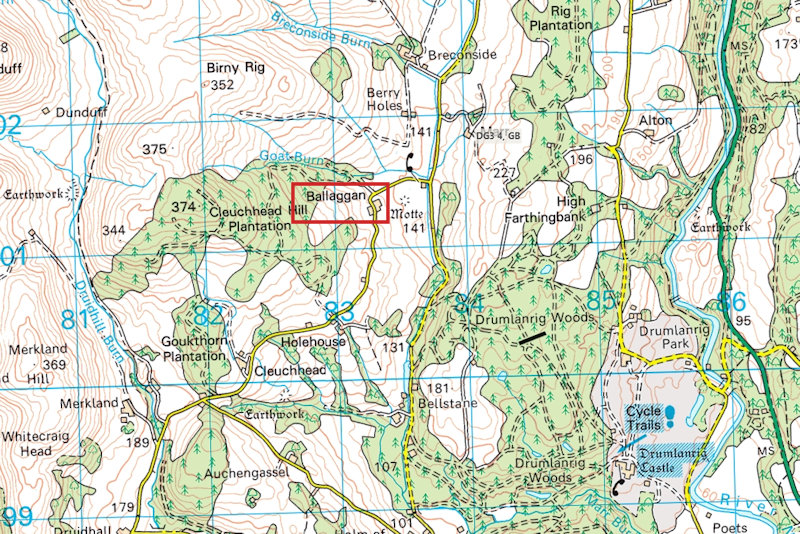
A while back I was re-reading Game of Kings for the Edinburgh discussion group, and thought, not for the first time, to take a closer look at the geography of that lovely passage introducing us to the hopelessly romantic 13-year old Agnes Herries, and giving us a glimpse of Richard’s wry sense of humour. In doing so I realised properly a couple of things that had lain at the back of my mind on previous readings, and was led into a little investigation.

Let’s firstly take a look at the placenames mentioned and see if we can trace a few things about Richard’s journey. All is not quite what it seems, even when you think you have some knowledge!

Incidentally, isn’t the first line of the chapter classic Dorothy?

On Sunday, the day after the affair at Lake of Menteith, Lord Culter was also taking aquatic exercise of a kind which all but turned his epithalamics into elegies.

How many of us had to look that phrase up to make sure we understood it? 😉 It could have come straight out of Lymond’s verbal extravagances.

Richard has been in South-west Scotland with a small harrying force taking advantage of Wharton’s retreat and then trying to convince some of the border families who are being hard pressed by the English to remain loyal to the Scottish cause. We are told that he’s had a fair degree of success and it appears that he has considerable powers of political persuasion as well as practical military leadership. How skillfully she builds up our knowledge of him without resorting to simple direct description.

He is on his way back home when he remembers that he has an escort task to undertake and

“…turned aside at Mollinburn with six horsemen to ride through the Lowthers to Morton.”

So our first task is to find Mollinburn and get ourselves oriented. This proved harder than expected as both Google and Bing are not great on Scottish minor placenames. I found a Mollinsburn, but it was much too far north – north-east of Glasgow in fact (which would confuse me further later on). I knew roughly where the Lowthers (a range of hills) were, though it was a very long time ago that I had once walked there and my memory of their precise position was sketchy.

Being in Slovenia with no access to my collection of paper maps back in Edinburgh I had to rely on the online variety, but it’s far harder working on a relatively small screen than a map spread out on a tabletop. Most online maps are lacking in any sort of detail even when you zoom in and out. Bing has a bit more detail than Google but here I was at first misled. I found Lowther Hill and Green Lowther but they’re quite far north – beyond the A702 road towards Wanlockhead – and I coulldn’t work out why Richard would have gone that far north and then back south for his meeting. However while casting about for further information I came across an inset online version of a Bartholomews map. Bartholomews  are an old Scottish firm of map-makers whose maps, while lacking some of the fine detail of the Ordnance Survey, were excellent for visualising an overall area or trip and tended to give prominent names to ranges of hills rather than naming all the individual ones. On that map the Lowthers were indicated in two sweeps – a long one running NNW and a shorter one running NNE and forming a V shape starting much further south than the individual hill from which the name comes. So I had a bit more to go on but still could find no sign of Mollinburn.

At that point I switched back to Bing. If you are set in Bing as being in the UK then you have a very useful faciity invisible to everyone else – at certain magnifications you get the option of viewing UK Ordnance Survey maps which are superbly detailed and the must-have map for hill walkers. I started looking on there and after a lot of scrolling around I found Mollinburn – not even a hamlet but merely a house just off the A701 road which runs between Dumfries and Beattock; about a mile south of the village of St Ann’s. So we have a start point. Now for the next named waypoint – Morton.

Again the search engines are useless – no sign of Morton. So it’s a question of looking to the next named place and trying to work back from there.

On Sunday afternoon, the party he was expecting came in from Blairquhan, and he left Morton on the Sanquhar road to take the Mennock Pass north.

Sanquhar is much easier to find – it’s a village away to the north-west on the A76 – and pulling back south you find Mennock which marks the entrance to the pass running north-east. So Morton must be somewhere on the road south of there. Sure enough, detailed perusal of the Ordnance Survey maps brings up the ruins of Morton Castle, situated above Morton Loch about ¾ mile east of Carronbridge on the A702, and with a few other Morton related names around it. It was built by the Earl of Morton who was a Douglas, and just across the valley to the west is that other Douglas stronghold, Drumlanrig Castle, of which more later.

We can now see that Richard rides across the southern slopes of the Lowther Hills from Mollinburn; either heading northwest and then west and skirting around the Forest of Ae, or going through the forest to begin with, though there’s no obvious path visible now. Whichever way it was the riding must have been rough and we can admire the stamina of the riders. He had started north on the Friday so I would imagine he probably stayed the night somewhere around Morton before meeting the party bringing Agnes on Sunday.

Here we must also look at where they were coming from. On previous reads I had rather lazily mentally assumed they were probably coming from around Terregles, but the text tells us explicitly if we care to check and given the recent English advance it then makes perfect sense. They were coming from Blairquhan where Agnes’ grandfather is based and we must assume that she was moved there to avoid the danger of being taken for ransom.

Blairquhan is about 40 miles to the west in South Ayrshire so a decent length journey on horseback just to get to the meeting with Richard. We know that he and Agnes are now heading for Stirling to join the court who have retreated there for safety after the eastern English advance towards Edinburgh. Morton to Stirling is another 75 miles, which again gives us pause to consider the problems of travelling in those times.

After a diversionary description of Agnes and her romances we come to the meeting with Dandy Hunter. Initially it’s not clear how much further we have travelled and on my earliest reading many years ago I initially assumed we had gone a considerable distance. The reason behind this was that I’d heard of Ballagan, the name of Dandy’s estate, and knew it was near Strathblane in the Campsie Fells, between Glasgow and Stirling. That seemed to make sense since they were headed to Stirling. However at this point things start to get geographically confusing and I realised I must be mistaken, though it was only now that I got around to resolving the matter properly.

Look,” said Hunter. “We’ll drown if we exchange news here. Come with me to Ballaggan – you could do with something hot inside you anyway.

Suggests they must be close to Hunter’s house…

But again, they had halted. The Nith, which lay between themselves and Ballaggan, ran unusually fast and high at their feet, and an outrider who drove his horse in at the ford thudded out again, wet to the stirrups.

Hang on! The Nith? That’s the river that runs from west of Sanquhar, turns south down the valley through Morton and down to Dumfries, then on till it empties into the Solway Firth. If we’d gone through the Mennock Pass we’d have left it far behind, so if we’re crossing it then we must still be in that valley and not have gone very far at all. And if that’s the case Ballaggan should be to the west of the river since Morton is on the east side.

And of course after the near disaster crossing the river they’re taken to Drumlanrig, because it’s nearer! (Slaps forehead!)

For they were in a Douglas household, instead of Hunter’s elegant, exhausted estate of Ballaggan. Alone and without help, Richard had brought Agnes Herries ashore: his own men were upstream and Andrew Hunter, far ahead, had been deaf to his shouts. But afterward, warned by the commotion, he had raced to their aid, wrapped the girl in his own cloak and carried both swimmers to Drumlanrig, the cavalcade following. Ballaggan was nearly an hour’s journey away and could wait. These two could not.

So, clearly the Ballagan I knew about away to the north cannot be Dandy’s place. Hmmm, wait, there’s two g’s in Dorothy’s version and only one in the Strathblane name! On its own that’s not a certainty since spelling in those times could be so variable and often changed over the years, but the geography is surely decisive. But searching for Ballaggan just seems to bring up Ballagan. Google knows best even when it doesn’t.

At this point I’m beginning to think that maybe Dorothy borrowed the name and tweaked it; maybe this Ballaggan is fictitious like Midculter and Flaw Valleys. No, that’s not her way. It must be based on something more.

Back to the maps. West of the Nith, north of Drumlanrig, south of Mennock. Nothing on Google – hardly anything named at all in that area on either normal map or aerial. Same with Bing.

An hour’s ride – how far can a horse travel in an hour – 8 to 12 miles apparently.

Comparing the two more detailed maps, Bartholomews and Ordnance Survey, you’d barely think you were looking at the same area. Hmmm just found a place called Buck Cleuch – could it be the place of the legend  – of the Scott who saved the King from a stag and was known thereafter as Buck Cleuch, later Buccleuch. Seems a bit westerly but who knows? It might be. But actually, maybe I am too far west myself, back up a bit towards the river, and change the magnification so we get more detail.

Come on man, you’re a search specialist, let’s delve a bit deeper and stop accepting what Google thinks we’re looking for. A bit more digging and we find a Ballaggan Cottage, the right spelling, Marrburn, Thornhill, Dumfries and Galloway, so it’s the right area, “within walking distance is Drumlanrig Castle”, surely we’re on the track now. “2 bedroom cottage situated within the Buccleuch Estate”, so these were Buccleuch lands – maybe that is the place of the legend.

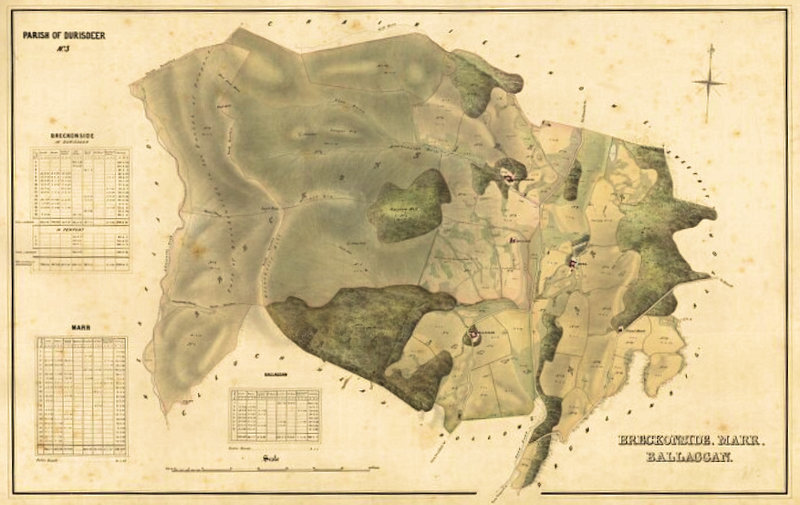
A bit more searching… Gotcha! National Library of Scotland, Estate Maps of Scotland, 1750s-1900s, Breckonside, Marr, Ballaggan. Queensberry Estate Plans, 1854
Volume 3. Courtesy of Buccleuch Estates.

Here’s a look at the whole map first

Ballaggan map

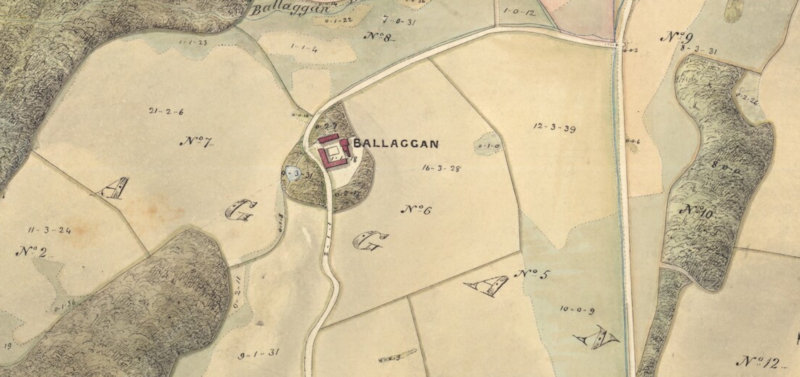
It looks beautifully hand-drawn but then you realise you can zoom right in.

Looks fairly small, and like more of a tenant farm than an estate, so maybe Dorothy was exaggerating or maybe it was bigger in earlier times, but we’ve found it; she did base it on a real place. Of course she was friends with the Buccleuchs so I wonder if she saw this original map that that is now digitally archived to the NLS, during a visit. Would be lovely to think so. You can view the map yourself at https://maps.nls.uk/view/129393259

Now, final task, relate that to the modern maps, adjust the magnification again and there it is. So obvious when you know where to look 😉

Well, after all that I have considerable respect for Richard and Agnes for their riding ability – a 13 year-old riding 115 miles, much of it over rough ground, to visit the court has a lot of grit.

And who would have thought that Dandy Hunter and his estate would turn out to be not quite what he appeared?!

Amazing how much investigative fun you can have with one small passage. Another toast dear lady! And I hope they have Talisker in heaven.

This post was prompted by a recent exchange on Twitter, where I’m pretty active (@spiderbill if anyone wants to follow along). The conversation turned to readers who had loved Lymond but couldn’t get into Niccolo (both series and character) and Ellen Kushner, who as many of you will know is a very well respected author and avowed Lymond fan, said she felt HoN was maybe too much writing technique and not enough heart.

Allison Stock, who has just read Lymond for the first time and has been entertaining us with her comments, and is now three-quarters of the way through Niccolo, asked in reply if Ellen felt “…was that BECAUSE of Nicholas as a character, or was Nicholas’s character a result of excessive technique?” @DunnettCentral then asked for other’s comments but I felt it was impossible to summarise such a complex issue in the 140 character format of Twitter. So here we are!

As always there were varied responses around the basic topic of which series people like best. One felt that Nicholas was arrogant; which slightly surprised me as that is usually a jibe thrown at Lymond, though I think I understand what was meant. Another said that Nick was motivated by revenge. On the other side the HoN was felt to be greater in scope – more diverse socially and culturally, and with more believeable women compared to the brilliant ones of the Chronicles.

This discussion took me back to the halcyon days of Dunnetworks and Marzipan discussions, where we compared and contrasted the two series on many occasions. It was interesting to hear one old chestnut revived – that the series you start with is the one you prefer. That was a common view for a long time and has some apparent merit as a common sense idea, but in fact in the days when membership of the email lists ran to many hundreds this was tested and found to not be anything like as clear cut as expected.

Now I should declare my allegiances at this point. I adore both series but if I was on that fabled castaway island with the miraculous choice of reading I would take Lymond every time.

It’s an emotional response without doubt – the characters in HoN are complex and intriguing and fascinating but for me the ones in LC are vivid and alive to the point where you feel you know them personally, and the emotional connections they make with each other and with us feel as concrete as those in our real lifes. In a very real sense we are in love with them, we yearn with them, we despair at the cruel turns which block their paths to happiness, we feel their confusion and their clarity, their disillusionment and their determination. We shout at the books in horror as we see a wrong decision or a missed opportunity. And we cry with Philippa when the worst possible tune is played by the band below her windowsill, and feel the stab in the heart as Lymond in the tower shuts down his body to maintain a flicker of life with her name on his lips.

For all the wonderful descriptions, the ingeniously deep plotting (by both author and protagonists), the richness of the interactions and the historical connections, I don’t quite have the same emotional response to HoN. There are times when it comes close: when you feel Gelis’ confusion over her feelings towards Nicholas, when you grasp something of Kathi’s hyperactive pesonality, or Tobie’s curiosity mixed with apprehension about where Nicholas could be heading next. But perhaps because the main character is so veiled in his emotions despite us seeing far more often through his perspective than we ever see through Lymond’s, it feels that there is a level of connection that is missing.

As an aside it reminds me of a conversation Dorothy and I once had. The discussion had turned to music and she was quizzing me about my tastes after I’d mentioned the coincidence that Alastair and I shared our choice of favourite symphony – Beethoven’s Seventh. She knew I was a former sound engineer and understood when I said there were certain types of music that I could admire and analyse despite not really liking them – classical voice for instance does very little for me. I can listen to someone like Fischer-Dieskau and marvel at his control and tone but I don’t actually like listening to lieder as preferred music as I just don’t connect to it emotionally, and to me emotion in music is everything. We discussed the music of Mozart, undoubtedly great, wonderfully flowing melodies, but for me the sheer genius and emotional impact of Beethoven, the crashing splendour and turmoil of Neilsen, the romanticism of Rachmaninov – that is the music (on the classical side) that I connect to the most. Dorothy understood, though being a lover of opera she did encourage me to listen to more of Mozart’s contributions to that field. (We never did get round to Italian opera before the conversation took different turns!)

Now all this is not to say that this is a fault in House of Niccolo, it is simply that my connection to the books is on a more emotional basis. Others may have a very different connection. I’ve often heard Ann McMillan wax lyrical about Nicholas for instance and there is no doubt that she has a connection to and perhaps an understanding of him that is different to mine. Another dear friend and long-time correspondent Tina Dallas also feels a closer bond to both Nicholas and Gelis than to Lymond.

Nor are my observations above a criticism of the writing in any way. Unlike some other authors (who may be more beholden to their publishers), Dorothy didn’t want to write a second series of Lymond. In returning to a series format after completing a near decade of research and writing of the outstanding King Hereafter, she wanted to do something new, something different, to challenge herself and her readers in different ways before leading them full circle. We see her swapping character traits and looks initially, maybe just to remind us that all is never what it seems and to show us that not only is there more than one kind of hero but that life often has many shades of grey, and that personal motivations can be even more byzantine than those of Lymond’s political landscapes.

But she was also developing an even wider and more complex series of ideas. For example, are heroes always heroes, are villains always villains, or are they entangled and intertwinded? Do heroes do bad things, whether for good or evil, and does that stop them being heroes? Do villains ever do brave things for the right reasons, and are they born villains or do circumstances create them? We’re a long way from the blatant evil of Graham Reid Mallett!

And what of the main characters themselves? One of the Twitter posters said that “Niccolo grew into his character; Lymond’s seemed fully formed at 21.” and that is also a key point when attempting to compare the series. Lymond has had the benefit of Sybilla’s immaculate upbringing and the resources available to a noble family. He has then been tested in the most dangerous of situations in the galleys and as a mercenary. He appears fully formed when we first meet him, though it is the missing/damaged aspects of his life and the unravelling of his psyche and the moral certainties he had relied on that forms a large part of the story. Nicholas’ story is starting earlier, with a far poorer education and troubled background, lacking mother or father and with only Marion’s necessarily detached guidance to steer him. His is a story of development, of what circumstances shape that person he becomes, of what demons – some obvious and others deeply hidden – he must face and overcome. It is also very much a story of moral development from the ground up, lacking guidance or moderation after Marion’s death, and possessed of a fearsome ability to create and set off intricate scenarios that have unpredictable consequences, he must learn from experience and sometimes take the wrong route before building a moral compass of his own.

Such differences and the added complexities of Nicholas’ story make fair comparisons almost impossible. We can read them in many ways but ultimately only marvel at the wordsmith’s skill and the exquisit world building. For me, the romantic chess player and emotional music listener, it is the first series that captures my heart a little more completely. For others, perhaps with Dorothy’s love of puzzles, and a deep appreciation of interwoven and multi-layered plots it may be the second.

But of course you know that she regarded them as one unified series of 14 books…

Is that the faint sound of laughter I hear?

I hope so, for in these precious gifts of books we have found a banquet under the heavens that will serve us for ever!

UK Book Re-issue

News is just appearing tonight of the planned reissue in the UK of all Dorothy Dunnett’s historical fiction books – The Lymond Chronicles, The House of Niccolo, and even, praise be, King Hereafter. Apparently the schedule is for the Chronicles and KH to appear in September 2017 with the HN following in 2018. The DDS press release is at http://dunnettcentral.org/archives/3925

Naturally I’m delighted that these magnificent books will once again be readily available for a new generation of readers and only hope that this time they get the promotion that they deserve. Last time (horrifying to think it’s heading on for 20 years since the last set of UK Lymond paperbacks came out) it felt like I was the only one doing anything to push them (at my then position with James Thin) and there seemed to be little budget behind the release.

Lymond for TV

The other big news – which makes me more optimistic about publicity for the books – is that a deal has apparently been done for a TV series based on Lymond, with the same company responsible for the recent Poldark remake.

This of course could be huge, and bring Dorothy to the attention of a much wider range of people. I suspect I may not be alone however in being just a bit concerned about how Lymond is portrayed on screen – and I’d be even more worried if it was for a film! If it’s done well and captures the feel of the books then wonderful, but if it over-simplifies the story, or changes the plot, then we devotees could be cringing in our shoes. However if we can’t popularise the books in the midst of the current climate surrounding the Game of Thrones series then maybe we never can.

Of course it won’t matter who they cast as Francis or Philippa, because none of us ever agree about that anyway! Probably half will love the choices and half will hate them. At least there’ll be lots of discussion.

And a final thought – maybe now the Scottish Book Trust will stop ignoring Dorothy every time they run a poll of top Scottish books!!