|
The event took place in one of the many Book Festival marquees
set up in Charlotte Square in Edinburgh's Georgian New Town. It
probably held about 200 or so people for the talk and although
not totally full was not far off it.
The idea of the talk was to give some idea of the relationship
between the author and editor on a long multi-volume series. They
started by looking at what type of books they were trying to produce,
and said that they were trying to avoid the Hornblower type of
story which has no overall plan but was a series of individual
stories. Richenda felt historical fiction is the most difficult
type to produce. Dorothy also felt that publishers were easier
to sell to at beginning of her career. She reiterated that Lymond
was all planned out but that the sources were often not recorded
(which is of course where Elspeth Morrison came in.)
Lymond was edited first in US, by Lois Cole and Bob Gottlieb.
Richenda came in during the House of Niccolo on Race of Scorpions
and had the manuscript dropped on her desk when she arrived -
which must have been a pretty intimidating start. She had to quickly
read the previous books to ascertain the style used before she
could do any editing. As we know, Dorothy was initially turned
down by various UK publishers and was first published in the US.
It was Alastair who suggested it be a series - Dorothy said "he
was a newspaper editor ....and she was used to obeying" :-)
Lymond was marketed in US as the next "Gone with the Wind" and
amongst other promotional events 10 salesmen walked down the street
in "Crawford tartan" ties advertising it. It was subbed to Cassell
in the UK, which she was very happy with as all her school dictionaries
were done by them so she felt they had a certain authority!
Cassell published Lymond then unfortunately in a change of direction
ditched their fiction list altogether. While Dorothy was looking
for a new publisher Rosemary Cheetham of Century phoned her. She
had read Lymond at the age of 12(!!) having been given the books
by her mother and had grown up with the ambition of publishing
them.
The US publisher wanted another series but Dorothy wanted to
do individual books instead (like the JJs). She decided to go
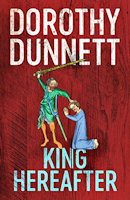
down that route but that first book turned out to be King Hereafter
which then needed 5 years research. Having decided that continuing
in that direction would mean only ever writing about another 3
books, she decided to go back to a series with Niccolo.
Returning to the Author/Editor relationship they said that publishers
frequently change direction and have different ideas on marketing
so it's difficult to maintain a consistent style. Richenda was
happy that they'd managed to keep the same jacket artist for all
the Niccolos, and also the same proofreader and copy editor. (This
is quite an achievement as there have been changes in Michael
Joseph and Richenda herself is now freelance rather than working
for them directly.)
During this section Dorothy mentioned that 3/4 hour earlier,
before having to leave for the talk, she was in the middle of
writing possibly the most dramatic section of the entire series.
So if it didn't turn out right it would all be our fault! ;-)
They next discussed secrets and how to keep them. To avoid giving
the plot away before people have read the book you need to look
at things like maps, genealogical tables, ends of chapters, news
of places that Dorothy has visited prior to writing each book,
etc.
One book had a 15th Century "Cod War". The artist produced a
superb exploding volcano but that was not allowed on the cover
as it would have given the game away. They came up with a cover
in which it was hard to tell the difference between sand and snow!
The map also had to be doctored to hide Iceland under the flap
and it was skewed to accomplish that - despite the mapmaker's
protests that you had to have north pointing straight upwards.
Blurbs which gave too much away were often problems with a new
publisher.
On the Scales of Gold shock ending - Richenda confessed to being
poleaxed and said she sometimes feels dim. ;-)
The main thing an editor does is checking on the shape, pacing
and clues to the development in the story. Dorothy never discusses
the story as she writes but once it is sent to the editors the
first phone call in response is very important. For instance Bob
Gottlieb contacted her about the Marion/Nicholas marriage, saying
that for the first time he felt she had cheated him of a scene.
He wanted to see a Marion/Felix scene to show Felix' reaction
and how Marion would deal with it. Dorothy wrote the scene in
an hour. If there is a reaction like Richenda's feeling poleaxed
she has to look again at the clues that she has included to see
if she needs to make things any clearer.
Fax machines came on the scene during the period of writing.
On one occasion having just finished a book Dorothy went off to
Arran on holiday to a chalet hotel which had one fax machine at
the reception desk. Richenda sent loads of long faxes which Dorothy
replied to standing at reception while guests gave her their keys
or instructions about their meals etc. :-) Some of the faxes were
somewhat explicit - they've never been back!
Richenda mentioned the Scales of Gold orgy scene - she had wanted
to know what Diniz was doing? As a result he lost his virginity
twice. She's still embarrassed about it!
Not just sex but fashions have changed over the years. Cruelty
to animals for instance is looked upon rather differently. Sentimentality
is not allowable so much now either. Game of Kings is set in aspic,
but the JJs are surrealistically in their periods. Readers have
to be aware when the various books were written to understand
how attitudes and fashions have changed.
Because of the unusual nature of the two series with the later-written
Niccolos preceding the time of Lymond, Richenda, who doesn't know
what the ending is to be, has the flow going forward whereas Dorothy
has it going backwards.
Consistency is very difficult. Regarding who does what, Dorothy
assumes she will have to check history since she does so much
original research which often hasn't been tackled by historians.
She also has to constantly work out what speed a camel goes at,
how fast and where and in what conditions ships can travel, the
speed of bullock carts, letters etc. She always tries to visit
the scene to check the terrain. As an editor - how much can you
trust the author? A naval author who Richenda worked with got
the ships bells wrong at one point and she started checking everything
- it turned out that half of his historical and technical descriptions
were wrong. Dorothy mentioned some racy French that was wrong
but the US editor picked it up. The Latin tag for Lymond's arms
was wrong - she hadn't used the accusative case - and the covers
had to be redone.
US editors don't have the same mores of the Europeans so there
is a difference in how their editors and readers approach some
passages.
Dorothy was given advice early on in her career that you must
make your villain as strong as possible or the hero won't be believable.
Colleagues must also be top of their tree.
|